
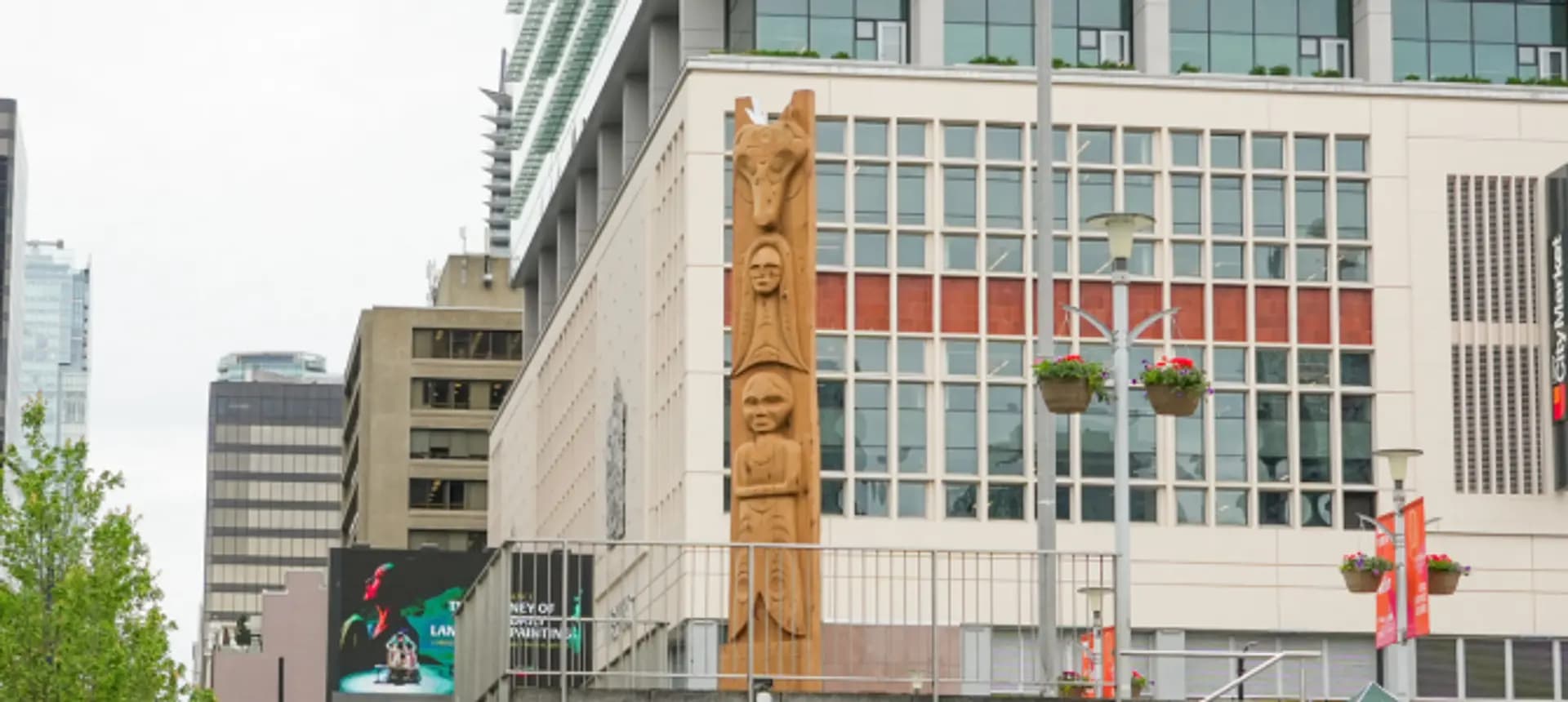
Syewá:l (Ancestors) House Post
Artist: Zac George
For səlilwətaɬ (Tsleil-Waututh) artist Zac George, his house post titled Syewá:l—meaning “Ancestors”—embodies the deep-rooted relationship between the local Nations and the Robson Street corridor, an area historically used for hunting and food gathering. The work also reflects his personal lineage.
The post honours his grandfather, the late Chief Dan George, who is portrayed toward its base, just above a traditional Coast Salish weaving pattern.
At the top sits a carved takaya (wolf) face, symbolizing the Tsleil-Waututh people having descended from the Wolf Clan, while the figure beneath it pays tribute to the women and grandmothers in his ancestry.
Unlike the totem poles commonly associated with northern Indigenous cultures, the Coast Salish peoples have long carved and continue to carve house posts—large wooden structures that support the beams of longhouses or mark significant ceremonial spaces.
These posts hold both architectural and cultural importance. Their carvings depict spirit figures, family crests, and ancestral stories, serving as powerful expressions of identity, heritage, and spiritual meaning for the Nations they represent.
Click Here to watch a Video of Zac telling the story behind the House Post
Explore More Places
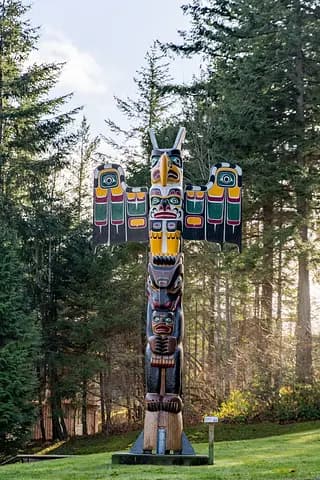
Thunderbird Bear Pole — Museum at Campbell River
Public Art
Original 1967 Sam Henderson pole replaced and raised in 2017; protected and blessed by the Henderson family.

Explore Songhees
Arts And Culture
Songhees Nation has approximately 600 members, half of which reside on Songhees Reserve #1A. This reserve is 60 hectares of fully developed residential and commercial land located adjacent to the Township of Esquimalt and the Town of View Royal.


Reliefs on Home Depot
Public Art
Reliefs serve as a reminder the plaza remains Wei Wai Kum land.

Revitalizing our Connections
Public Art
Discover diverse art installations across Vancouver, showcasing local artists and cultural connections.


təmtəmíxʷtən (Belcarra Regional Park)
təmtəmíxʷtən (Belcarra Regional Park), also known as “the biggest place for all the people”, is one of many Tsleil-Waututh Nation villages surrounding səlilwət (Burrard Inlet). Since time out of mind, the entire landscape of this area was used by the Tsleil-Waututh community for settlement, hunting, resource harvesting, sacred/health sites, and ceremonial uses.

Blanketing the City V: (Rescue) (Aftermath) (Wealth of the Land)
Blanketing the City V: (Rescue) (Aftermath) (Wealth of the Land) mural by Debra Sparrow (xʷməθkʷəy̓əm), Chief Janice George (Sḵwxwú7mesh) and Angela George (səlilwətaɬ).

Quinsam Crossing Welcoming Figures
Public Art
Figures inspired by poles from a Liǧʷiɫdax̌ʷ village near Cape Mudge, representing a hospitable welcome.
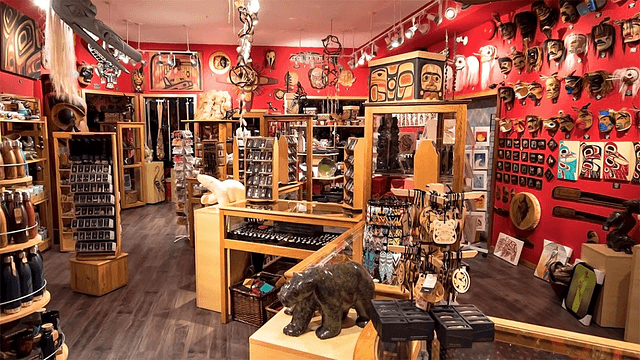

Ahtsik Native Art Gallery - Indigenous Tourism BC
Explore beautiful Indigenous woodcarvings, jewelry, masks, and more in Port Alberni, British Columbia.

Walmart Plaza Welcoming Figures
Public Art
Works that remind visitors the plaza remains Wei Wai Kum land; includes T´łisala (sun) and a Thunderbird over Dzunuk’wa.
